

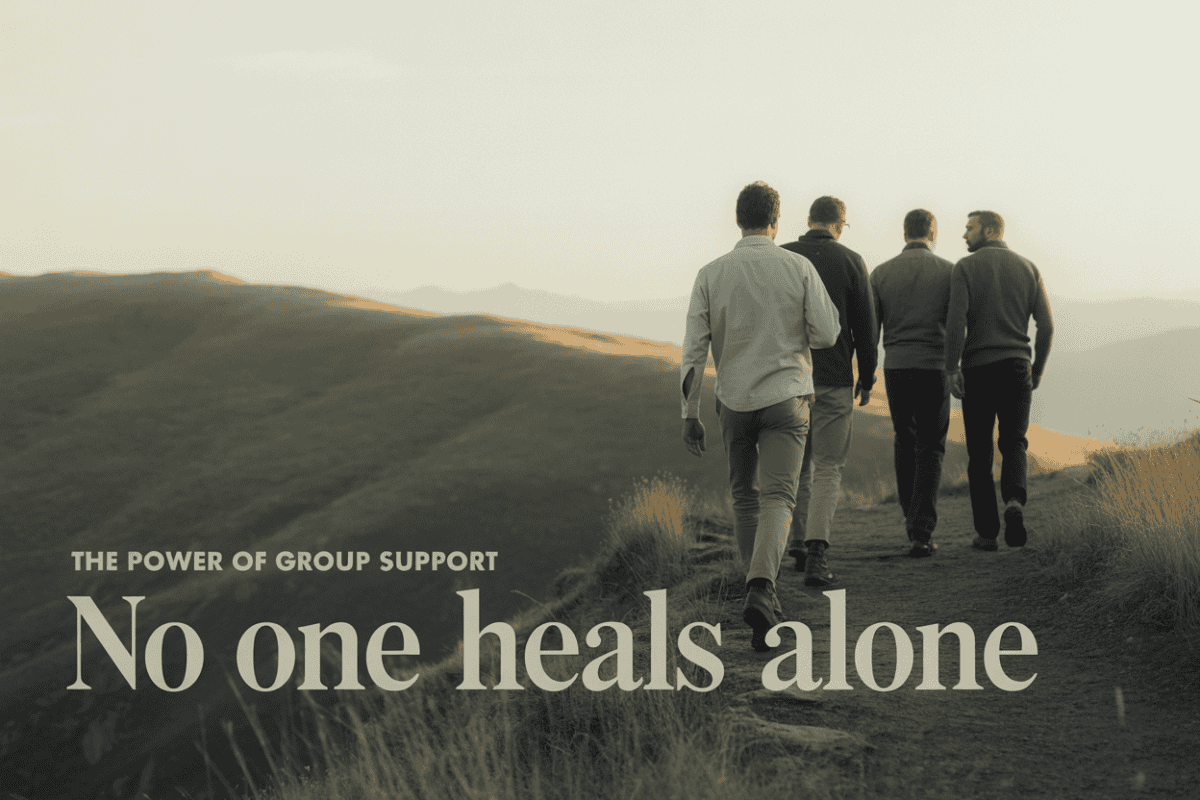
If the last article was about the danger of going it alone, this one is about the antidote. Recovery is not a solo climb. The men who make it, and keep it, almost always do so inside some kind of tribe — a group of people who get it, who hold them accountable, and who remind them they are not the only one. Finding that tribe is one of the most protective moves in all of recovery.
Why the group works
There is a reason mutual-aid groups, peer support, and group therapy have been central to addiction treatment for the better part of a century. It is not sentimentality — it is mechanism. Peer support and group-based approaches do several things no individual willpower can:
- **They break shame.** Hearing another man describe your exact secret — and survive telling it — dissolves the isolation that keeps addiction alive.
- **They provide accountability.** A tribe notices when you disappear. That visibility is protective in a way that going it alone never is.
- **They offer proof.** Sitting across from someone a year or five years sober is living evidence that recovery is possible, on the days you cannot believe it yourself.
- **They meet a basic human need.** Belonging is not a luxury. The nervous system settles in the presence of safe others.
Major treatment research consistently lists group and community-based support among the most effective components of long-term recovery.
Connection is the opposite of addiction. Where isolation feeds it, belonging starves it.
Why men, especially, need this
For men raised on self-reliance, the group can be the hardest part of recovery to accept — and the most transformative. Many men have never once sat in a room and told the truth about their inner life. Doing it among other men who are doing the same can be the first time they feel genuinely understood. It rewrites the old script that says a man handles everything alone.
There is also something specific about a room full of men holding each other to a standard of honesty and showing up. It replaces the isolation of the “strong silent type” with brotherhood — strength that is shared rather than hoarded.
Connection starts early
A man does not have to wait until he is months into recovery to find this. It can begin in detox itself. At Valiant Detox, a small program — only a handful of patients at a time — means a man is not anonymous; he is among others who are walking the same first steps. Knowing what to expect makes it easier to arrive open rather than guarded.
From there, the tribe widens: group therapy, 12-step and other mutual-aid communities, sober friendships, and structured programs. For men ready to go deeper after stabilizing, our men’s residential program is built around exactly this kind of brotherhood and clinical work.
The takeaway
You did not get into addiction alone, and you will not get out of it alone — not because you are weak, but because no one does. The men who last are the ones who let themselves be carried for a while, and who carry others in turn.
That tribe is out there, and the door into it is closer than you think. Call Valiant Detox at (720) 796-6885 to take the first step into a room where you do not have to pretend anymore.
Frequently asked questions
It breaks shame, provides accountability, offers living proof that recovery is possible, and meets the basic human need to belong — things individual willpower cannot do alone.
No. A “tribe” can be 12-step, group therapy, peer support, or sober friendships. The key is connection, and there are many paths to it.
It can begin in detox itself. Valiant’s small program means you are among others walking the same first steps rather than going it alone.

